arcade.ly is in Gopherspace
When I announced the MCP server I mentioned my plan to create a gopherspace version of arcade.ly. And now, here it is: gopher://gopher.arcade.ly:70.
If you’ve never come across it, Gopher is a way of browsing the internet that dates from 1991, just before the world wide web was publicised (I won’t say born because I think an early version might have been available internally at CERN in 1989).
A Gopher site is made up of menus of documents. Usually these are simply sent as plain text, although later unofficial extensions added support for different kinds of documents. But it’s still much simpler than the web. You can link to and serve up images, but there are no scripts, no styles, no cookies, no tracking, no adverts, and none of the other modern distractions we’ve come to grudgingly tolerate (or not - try uBlock Origin).
It’s fast and simple, and it’s very much focussed on the content rather than the presentation.
It did have a couple of limitations that, along with the rise of the web, meant that its popularity was waning by the end of the 1990s.
The first is no kind of security: no authentication, no encryption, none of that. Obviously no good for ecommerce and a serious worry for many other kinds of business, especially as hacks and viruses became more commonplace as the internet grew in popularity.
The second, and maybe the bigger problem, is that in 1993 the University of Minnesota decided to charge licensing fees for its Gopher software and there was serious concern amongst the wider community that they might start to do the same for independent implementations. This rolled on for a few years unti UoM eventually relented in 2000 but, by that time, the damage had been done: Gopher had suffocated in its tunnels, and the web had taken over. In fact that I’d bet a lot of those who joined the Internet revolution of the late 1990s had never even heard of Gopher.
But it never quite went away thanks to a dedicated cadre of enthusiasts, hobbyists, retro computing aficianados, and more recently a resurgence of advocacy for its simplicity by the small web community.
So, ironically, all the way here in 2026, Gopher - this 35 year old communication protocol - might be growing in popularity.
There’s even nowadays what could be seen as a more modern version of Gopher (though not intended to be a replacement) called Gemini (not to be confused with Google’s AI assistant). But I haven’t yet exposed a Gemini version of arcade.ly (be reassured though: that will come soon).
But why?
I meeeeeeeeean… yeah… fair question. But really the answer is the same as for the MCP server: it’s a bit of fun. And because I can. There’s no serious reason for it beyond that, but this is my personal site full of things that interest me, and Gopher interests me so I did it.
And it does fit: I like my homages to old games, I like my 80s and 90s aesthetics, I like listening to vapourwave when I’m in a certain kind of mood, and I’m enough of a cliche to use a fixed width font for body content to boot. This blog is mostly words and code, so exposing it as plain text reasonably formatted is almost no effort (although now I’ve done it, inevitably I can see some room for improvement, so if you spot any issues do get in touch).
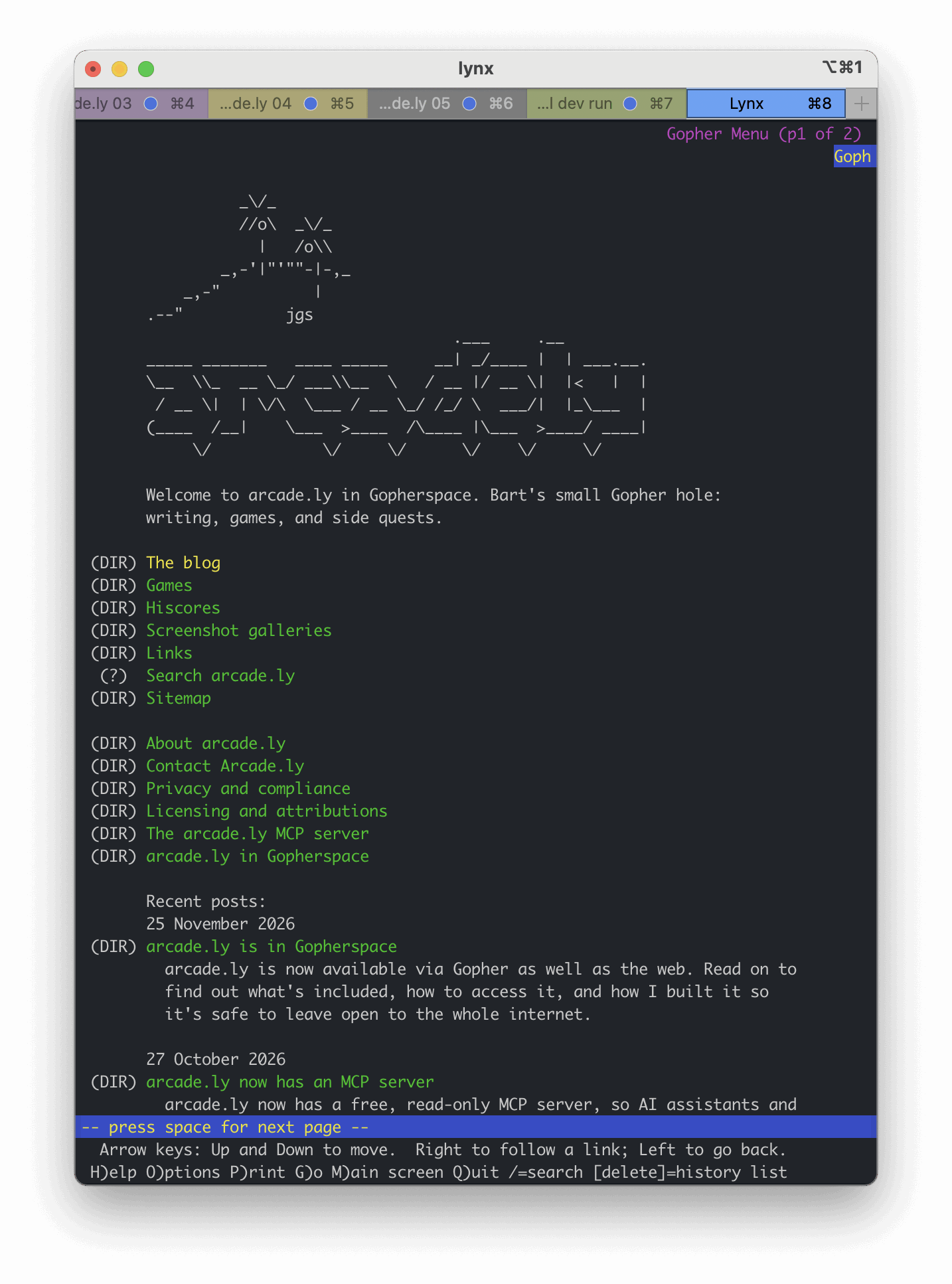
Starting prior to dipping my toe in the water with Gopher, it’s always been an objective to make sure the site works reasonably well in the Lynx web browser, because doing so is a decent starting point for a site that scores decently for accessibility1. The side-benefit is that the step from “works well in Lynx” to “works well as a Gopher site” isn’t a particularly big one.
Anyway, I’ve realised I’m increasingly covering the extremes of online information distribution here (at least of those that work on TCP/IP), from 35 year old Gopher, through HTTP and HTTPS, and right up to the minute with MCP, for information discovery and exposure. Maybe I should offer a version of the site that can be browsed by email, or even branch out into the real world: start shipping wads of printouts in filing cabinets to local libraries, or add support for telegraph and smoke signal transmission (sounds like a perfect IoT/embedded side project, right? Right?).
Aside
I also kind of want to resurrect Gopher VR, which is if anything a niche of a niche, but that’s for another day.
What’s included?
I’ve tried to get the whole site into Gopher. Obviously not the games, because they’re interactive, but pretty much everything else is in there.
One thing I have included from the games is the hiscores, really for no other reason than for the sake of it. I haven’t yet included the instructions because of the way they’re embedded in the game pages, but it’s certainly something I could do in future.
Gopher doesn’t allow for things like inline images, but it does include support for serving images as documents, so they’re all included. And for text documents, I simply serve them up as plaintext for the ultra-authentic Gopher experience, even though there are unofficial extensions that support other document types.
If you do spot anything missing that you think should be in there, give me a shout.
How do I read it?
Full instructions are here, but in brief:
- In your web browser, through Floodgap’s web-to-Gopher gateway/proxy, or using one of The Overbite Project’s extensions.
- In a Gopher client. Lagrange great, and available for most mainstream devices and OSes. I mostly use Lynx.
How it’s built
Site content
The whole Gopher site is generated every time the site is built, from the same Markdown and Pug templates as the blog and other pages.
The build writes out the over the wire representation so all the Gopher server has to do is be a fairly dumb pipe to transfer those files to clients, and then I simply rely on the OS’s page cache to keep popular pages in memory.
The build also enforces a bunch of criteria: linked pages and images must exist, images cant be too big, text must be UTF-8 (although I believe OG Gopher may have been ASCII only, UTF-8 has been supported for a long time). The CI process also checks that everything loads and there aren’t any broken links (at least not internally - I still need to decide what to do about external links that become stale or break, especially for Gopher sites where, AFAIK, there is no equivalent to the Internet Archive.
Exposing it safely on the internet
This was the biggest challenge, and ended up being more work than I’d expected.
With a website it’s fairly straightforward: you sit it behind a CDN (I’m still using Cloudflare for historical reasons but am looking at alternatives as and when I get time), which hides its IP, and then you harden the box/VPS/whatever you’re using, and if you need to maybe use something like Tailscale to help with deployments so the web host is always connecting outbound rather than the other way around.
Your CDN protects you from a lot of inbound nastiness: DDoS, known bad IPs (within limits), and even hacking attempts.
Unfortunately you don’t get any of that with Gopher, and that’s where the problems began. My intent had been to see if there was a Gopher server implementation I could already use on npm but, although implementations do exist, it became apparent that none of them were going to be suitable.
For example, node-gopher never made it past version 0.2.0, is explicitly marked as work in progress, and hasn’t had a new version published in 10 years. It’s also GPL-3.0 licensed which would make it awkward to work with, or at least reduce my options for using it.
Another option is gopher-server but, again, whilst this one made it to 1.0.0, it’s not had an update in ~6 years and it contains a number of bugs that would make it unsafe to open up on the public internet.
A lot has changed since these packages were last published, including the rise of AI-backed cyberattack discovery and automation, so there’s no way I could use one of these packages unmodified.
So my choices were to either fork one of these packages and improve it, or to start from scratch and roll my own. In the end, Gopher being a fairly simple protocol, and much of the complexity not being Gopher itself, I opted for the latter approach.
Things I needed:
- Blocklisting for known bad/troublesome clients
- Separation from the website
- Robust firewall configuration
- Rate limiting
- Exponential back off for clients that generate a lot of errors
Blocklisting
arcade.ly uses a blocklist to ensure that many malicious clients are simple unable to access the website. This is built from a number of sources, which I describe below, and for the website is applied at three levels:
- CDN
- Firewall
- Application
The CDN is our first line of defence, blocking traffic from many known malicious addresses. But, unfortunately, there is a limit to the number of entries you can configure in the blocklist and that limit is a lot smaller than our full blocklist!
Our second line of defence is at the firewall firewall which blocks all traffic from all IPv4 and IPv6 addresses in our blocklist.
Our third line of defence is the application itself, which checks all inbound requests against our blocklist and rejects any requests from addresses on that list. Theoretically this never gets triggered because of the firewall: in practice, I like and recommend defence in depth.
Unfortunately Gopher loses one of those layers of protection: the CDN. Maybe one day Gopher will once again be popular enough that CDNs support it natively, but I’d be pretty surprised if it was on anyone’s roadmap at the moment.
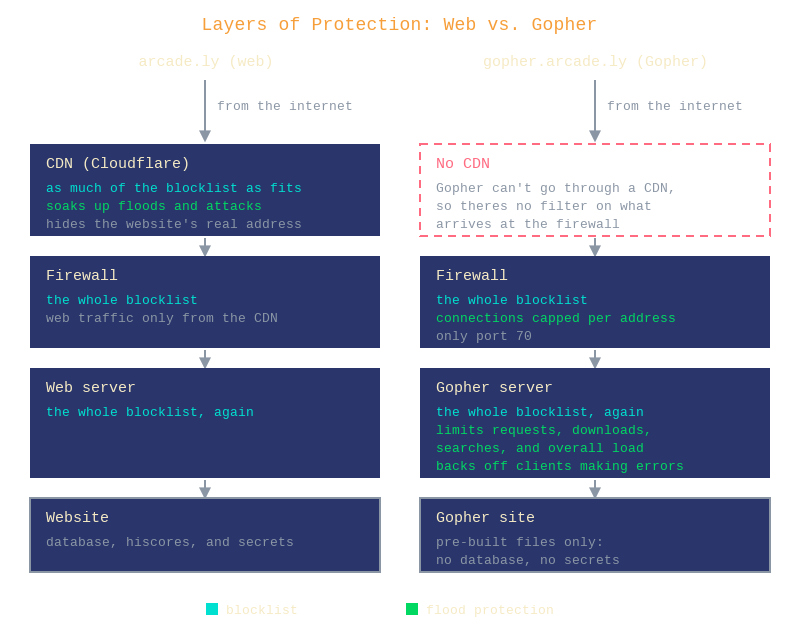
That’s sort of OK - not a disaster anyway - because I’m confident of the firewall configuration, and we can obviously also apply the same blocklist at the application level within the Gopher server. That and the host itself is regularly patched and backed up on an automated schedule that doesn’t rely on me to do anything.
Aside
For any project I always recommend automating as much of your DevOps as you can, both to keep your operations safe, and to limit the tax you pay on product or service development. That’s especially true security patches and updates. However, if anything, I think automations is even more essential for side-projects or really any system or service where you need it to run unattended for long periods of time.
But it does mean our Gopher host is now unprotected from flooding or DDoS style attacks, so we need to take what precautions we can both at the host and the application level. The blocklist operating at those levels is obviously part of that, and I’ll talk in more detail about other protections I’ve implemented below.
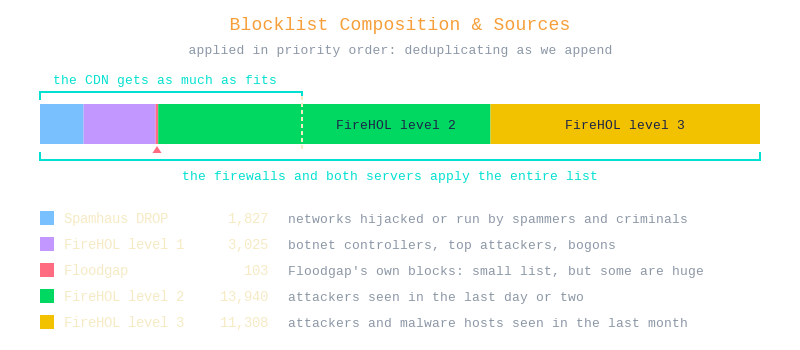
As for the blocklist itself, it’s automatically updated from several sources every 24 hours: Spamhaus, FireHOL, and even Floodgap’s own blocklist2. I also pick up and block a list of referrer spam domains from Matomo.
Separation of gopher.arcade.ly from arcade.ly
I run the Gopher server separately from the website and on a separate IP address. It has no access to the website’s database (which is used for storing hiscores from the different games), and no access to any of the website’s secrets (including the TLS key).
So if the Gopher server is flooded or it crashes the website should just keep on trucking.
Firewall
I’ve already talked about this in more depth regarding the blocklist but, with the separation of the website and Gopher site, I also wanted separate firewall configurations.
Both of them include the blocklist, but obviously the the Gopher configuration:
-
Only opens port 70
-
Applies aggressive connection caps from any single IP address
The latter goes some way to mitigating certain kinds of flooding attacks.
Gopher server
The Gopher server itself also implements the blocklist, but also implements rate limiting on requests, downloads, searches, and also overall load. If it gets too busy, it will start refusing connections.
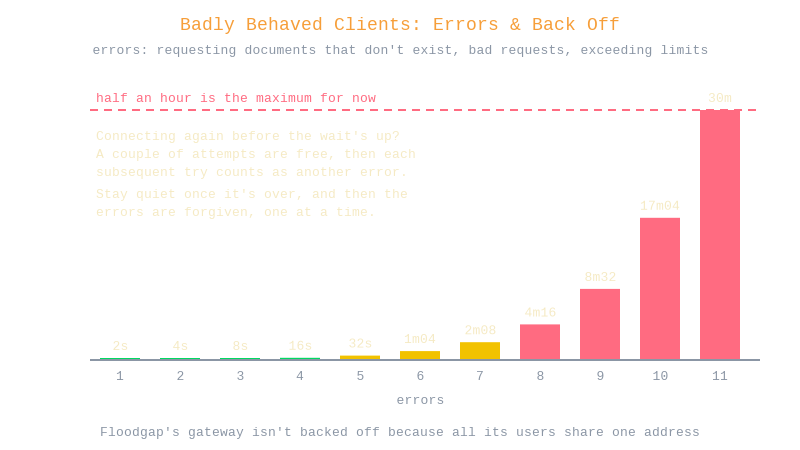
It also tracks error rates: clients that are generating a lot of errors, for example by requesting documents that don’t exist, will be exponentially backed off and further requests will be refused until the back-off period has expired. I try to be friendly here by including the length of the back-off period in the error message it returns. The period goes all the way from 2 seconds up to half an hour, so it is kind of hardcore on the high end.
The need to have these capabilities, apart from the bugs and security concerns in Gopher servers already available on npm, was a major driver for using Claude to build a fresh Gopher server implementation from scratch.
If you’re just browsing the Gopher site normally you shouldn’t run into any problems or rate limits at all.
Floodgap’s gateway gets special treatment here because everyone using it looks like they’re accessing the site from teh same address. As a result, I’ve given Floodgap a more generous limit so that one person making typos in addresses doesn’t cause everyone using the gateway to get rate limited!
What are my plans for the home-rolled Gopher server?
I’m mulling this. The temptation is to see if I can extract the Gopher server from arcade.ly and publish it as a new npm package and on GitHub/GitLab/Codeberg/wherever. That would be pretty easy to do in some ways, because it’s very self-contained.
What I do wonder is, despite that separation, is it too tied to the requirements of arcade.ly to be really useful as a general Gopher server? So that’s things like:
-
The way the Gopher site is built and the fact the server is really just a dumb pipe for serving up over the wire representations that are already stored on disk
-
The blocklist mechanism and the way this is tied into deployments and firewall configurations
-
The other protections/precautions from flooding attacks (although I think these would be something any Gopher server would want, and would be easy to make configurable)
The other factor is that I’ve started with Gopher, but I don’t want to stop there. I also want to serve up arcade.ly over Gemini.
Now much of the work I’ve done for Gopher should be reusable for Gemini. Depending on which route I take I could end up with my own Gopher server implementation but an off the shelf Gemini server, separate home-rolled servers for each protocol, or a single server that can handle both Gopher and Gemini.
I haven’t really thought about it in a lot of detail and I haven’t made any decisions yet but, depending on the outcome, that would obviously influence what and how I might choose to open source any implementation.
I’m also slightly wary of putting a project out there that I’m then solely responsible for maintaining (contributions would be welcome!), or that falls into disrepair (as with other Gopher server implementations on npm) because of changing life priorities and interests. On the other hand, this is my personal site, so it will at least need a secure Gopher server implementation, so I’m sure I wouldn’t struggle too much to at least keep it patched.
I’ll probably have more to say about this within the next few weeks or months so watch this space.
Try it
Have a browse at gopher://gopher.arcade.ly:70 or, if you don’t have a Gopher client to hand, through Floodgap’s gateway. If something doesn’t work, or looks odd in your client of choice, please get in touch.
Footnotes
- 1
Sitewide, excluding the games, I target WCAG AA conformance. The kind of arcade games I have on the site currently are not, according to my current understanding, amenable to AA conformance, but I’m certainly open to targeting that for other types of games where it might be possible if I develop more in future.
- 2
Floodgap publishes a Gopher document where its blocklist is published. I got in touch with Cameron Kaiser to ask if he’d be happy for arcade.ly’s CI/CD pipeline to read it every 24 hours, and he was kind enough to grant permission. In a similar vein I’m certainly open to publishing arcade.ly’s combined blocklist for others to use, but I need to check whether there are redistribution restrictions on Spamhaus, FireHOL, and Matomo. The way arcade.ly’s blocklist works is actually a bit harsher than Floodgap’s in that we just take all those dodgy addresses from the combined list and block all traffic from all of them.
Filed Under
Category:Web Dev
Tags:gopher · small web · retro · node.js · security · devops
I'd love to hear your views.
You can drop me a line, or write your own post and send me a link. Anything interesting I receive I'll add here.